Eye Health
Thinking About Blepharoplasty in the Inland Empire? Check Your Eyelid Muscles First
If you have been searching "non-surgical blepharoplasty near me" or "how to fix droopy eyelids without surgery," you are not alone. Eyelid surgery is one of the most common cosmetic procedures in the country, and the American Society of Plastic Surgeons puts the average surgeon's fee at roughly $3,400 for upper lids and $3,900 for lower lids, before anesthesia and facility costs.
But here is something most people in Rancho Cucamonga, Chino, and across the Inland Empire never hear before they book a surgical consult: not every tired, droopy-looking eye is a skin problem. Sometimes it is a muscle problem. And muscles can be trained.
That difference matters, because it changes which treatment makes sense for you.
Skin, Fat, or Muscle? Three Different Reasons Your Eyes Look Tired
When you look in the mirror and see heavy or sagging eyelids, one (or more) of three things is usually happening:
- Extra Skin: Over time, upper eyelid skin stretches and can fold over the lash line. In significant cases it can even block part of your vision.
- Fat Pads That Have Shifted: The puffy "bags" under the eyes often come from fat that pushes forward as the supporting tissue weakens.
- Weak Periorbital Muscles: The muscle that circles your eye (the orbicularis oculi) is the same muscle you use to blink. As it loses tone with age, the lower lid can loosen and drift down, the eye looks tired, and your blink gets lazier.
Traditional blepharoplasty is designed for the first two: a surgeon removes or repositions skin and fat. It does not strengthen the muscle. That is why it helps to know which one you are dealing with before you decide anything.
Why an Eye Doctor Is a Smart First Stop
Your eyelids are not just about looks. They spread your tears across the eye every time you blink. When the lower lid sags or the blink becomes incomplete, tears evaporate faster, and the eye surface dries out.
In the Inland Empire, that is a bigger deal than in many places. Santa Ana winds, dry summer heat, long commutes on the 10 and the 15, and hours of screen time all pull moisture from your eyes. A loose lower lid on top of that can mean burning, grittiness, watery eyes, and redness that eye drops never quite fix.
So "tired-looking eyes" and "dry eyes" are often the same story told two ways. At Inland Family Optometry, a dry eye evaluation looks at your tear film, your oil glands, and how completely you blink. That tells us whether your lids are part of the problem, and whether a muscle-based treatment could help both how your eyes feel and how they look. Not sure where you stand? Start with our free Dry Eye Quiz.
What Is OptiLIFT? A Non-Surgical Option for Lower Eyelid Laxity
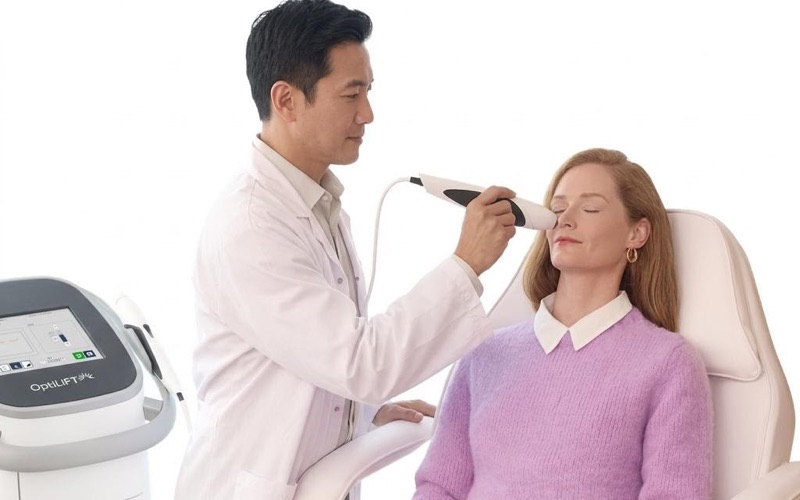
OptiLIFT is a Lumenis treatment built specifically for the area around the eyes. Instead of cutting, it uses Dynamic Muscle Stimulation (DMSt): gentle electrical pulses that activate the periorbital muscles and make them contract, a bit like a guided workout for your eyelids. Over a series of sessions, the goal is better muscle tone, a lifted lower lid, and a fuller, more complete blink.
OptiLIFT combines up to three technologies in one device:
- DMSt (Muscle Stimulation): Tones the muscles that support the lower lid.
- Radiofrequency (RF) Energy: Gently warms the deeper skin layers to support collagen and elastin for smoother, firmer skin around the eyes.
- Optional RF Microneedling: Adds resurfacing for the delicate skin around the eyes.
Typical treatment is a series of four sessions. There are no incisions, no injections, and no downtime, and it is suitable for all skin types. Most people go right back to work or school.
What the Research Shows
OptiLIFT was studied in dry eye patients and published in Clinical Ophthalmology (Chelnis & Chelnis, 2025). In that study, patients saw:
- Tear breakup time improve from 2.4 seconds to 9.1 seconds (a 286% improvement), meaning tears stayed on the eye far longer
- About a 70% improvement in blink rate and quality
- A 75%+ decrease in lower lid laxity
- A 78% decrease in meibomian gland dysfunction score
Individual results vary, and no treatment is guaranteed. But for people whose droopy lower lids and dry, tired eyes come from weak muscle tone, these numbers are why this approach is getting attention.
OptiLIFT vs. Blepharoplasty: An Honest Comparison
OptiLIFT:
- Targets weak periorbital muscles, lower lid laxity, and skin texture
- No incisions and no anesthesia
- No downtime
- Improving blinking and dry eye is a primary goal
- A series of four sessions
Surgical blepharoplasty:
- Targets excess skin and fat pads
- Incisions with local or general anesthesia
- Typically one to two weeks of swelling and bruising
- Improving blinking is not a goal of the surgery
- One procedure
When surgery may still be the right call: if heavy upper eyelid skin is hanging over your lashes or blocking your view, or you have large, prominent fat bags under your eyes, OptiLIFT will not remove that tissue. In those cases, we will tell you so and point you toward an oculoplastic surgeon. Some people even combine both: surgery for the excess tissue, and muscle toning for function and long-term support.
Who Is a Good Candidate?
OptiLIFT may be a fit if you:
- Notice your lower lids sagging, loosening, or "pulling down"
- Get told you look tired even when you have slept
- Have dry, burning, or watery eyes that drops have not solved
- Want a lift without surgery, needles, or time off
- Are not ready for blepharoplasty, or want to delay it
Your doctor will review your health history and goals to confirm the treatment is appropriate for you. Many patients pair it with Lumenis IPL for a complete approach to oil gland health and lid function.
Frequently Asked Questions
- Is OptiLIFT the same as non-surgical blepharoplasty? "Non-surgical blepharoplasty" is a marketing term that covers many treatments, including lasers, fillers, and plasma pens. OptiLIFT is different because it works on the muscle that supports your lower lid, not just the skin surface.
- Does OptiLIFT hurt? Most patients describe a tingling or tapping feeling as the muscles contract. There are no needles unless you choose the optional microneedling add-on.
- How many sessions will I need? The standard protocol is four sessions. Your doctor may suggest maintenance based on your results.
- Can it help with dry eye too? Yes. Improving how completely you blink is one of the main goals, which is why OptiLIFT is offered alongside our dry eye care.
- Do you offer OptiLIFT in both offices? Request a consultation and choose either our Rancho Cucamonga or Chino office. Our team will confirm the best location and time for you.
Book Your Complimentary OptiLIFT Consultation
Before you commit to surgery, find out what is really behind your tired-looking eyes. Inland Family Optometry offers complimentary OptiLIFT consultations for new patients in Rancho Cucamonga and Chino. We will look at your lids, your blink, and your tear film, and give you an honest recommendation, even if that recommendation is surgery.
Call (909) 987-4919 (Rancho Cucamonga) or (909) 628-1226 (Chino), or request your complimentary consultation on our OptiLIFT page.
Results vary. OptiLIFT is intended for use by a licensed healthcare practitioner and is not intended to diagnose, treat, or cure a medical disease. Your doctor will determine whether the treatment is appropriate for your goals and health history.
Ready to schedule your visit?